When extraordinary service becomes ordinary to those who serve...
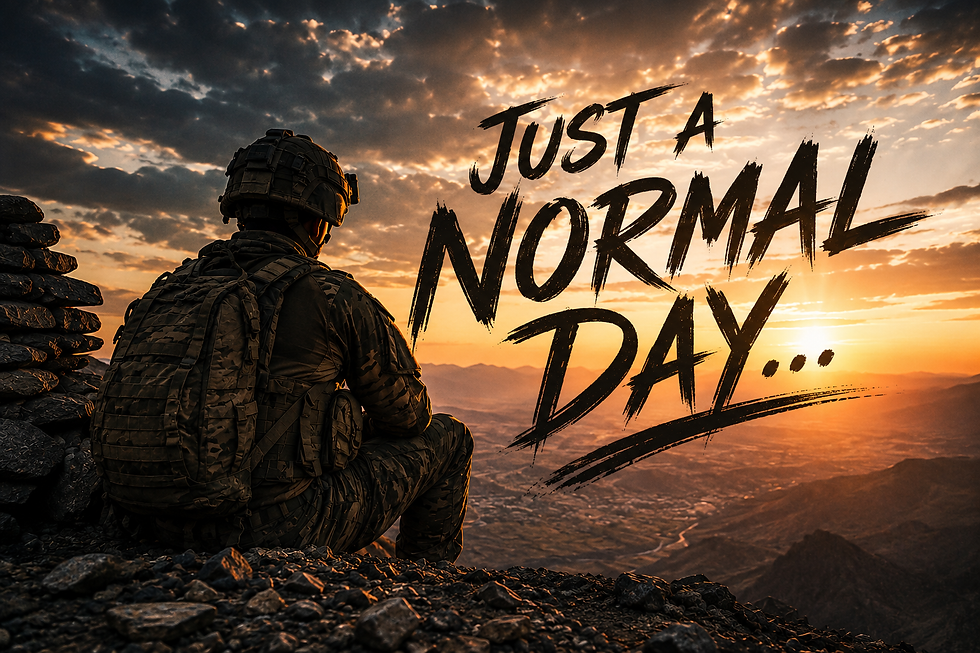
I've been reflecting on a conversation that happened a few months ago, a story relayed to me by an individual within the armed forces community that many of you will know. For that reason I will ensure I provide suitable anonymity in respect of their position.
After listening to them recant this particular story, my reaction was immediate. I thought it was extraordinary. Their response was more interesting.
“In fairness, it’s not exceptional. It was a normal day. It’s just that on this occasion, people of senior rank witnessed it.”
I have kept returning to those words. It was a normal day. There is something deeply revealing about them. Not because the events were normal in any ordinary meaning of the word, but because they had become normal to this individual. And perhaps that distinction tells us something important about military service.
When extraordinary becomes normal
Human beings are remarkably adaptive. Psychologists have long studied the tendency for the emotional intensity associated with circumstances to diminish as those circumstances become familiar. Frederick and Loewenstein describe hedonic adaptation as a reduction in the affective intensity of favourable and unfavourable experiences. Earlier work on adaptation and habituation similarly suggested that our assessment of present circumstances is influenced by what previous experience has taught us to regard as normal.
The concept is often illustrated through changes in happiness. New possessions cease to feel new. Promotions become jobs. Houses become rooms. What initially commands our attention gradually becomes part of the background. But the principle raises a more uncomfortable question:
What happens when the thing to which someone adapts is not comfort, wealth or success, but responsibility, danger and extraordinary human performance?
Military service offers an unusually powerful setting in which to consider that question. Things that appear remarkable when viewed from outside can become occupationally unremarkable to the people doing them. Carrying responsibility for other people's lives. Making decisions without complete information. Continuing to function while exhausted. Suppressing fear sufficiently to act. Accepting personal risk because others depend upon you. Seeing people injured. Losing friends. Remaining responsible for everyone else while experiencing those things yourself.
None of that becomes objectively trivial merely because someone has experienced it before. But familiarity changes the frame of reference. The exceptional becomes the baseline.
“Just doing my job”
There is a phrase heard repeatedly around military service: “I was only doing my job.” It can sound like modesty. Sometimes it undoubtedly is. But I wonder whether something more profound is occurring. Military professionalism establishes its own normative standards. Behaviour that an outsider might describe as courageous may be understood by the individual simply as competent. Sacrifice may be experienced not as sacrifice but as duty. Endurance becomes expected. Responsibility becomes part of the appointment. The threshold moves. The person does not necessarily think: I have done something extraordinary. They think: I have done what was required of me.
And once “what was required” becomes the benchmark, remarkable conduct becomes remarkably difficult for the individual to recognise in themselves. This should not surprise us. The British Army explicitly constructs leadership around responsibility, trust, service and empowered action. Its leadership doctrine describes leadership as being rooted in moral foundations, closely associated with Mission Command and executed “in the service of others”. Mission Command, in turn, deliberately decentralises decision-making, granting subordinates freedom of action while placing upon them responsibility for acting to achieve the superior commander's intent.
That produces highly capable people. But it may also produce people whose coneption of ordinary professional behaviour would appear anything but ordinary elsewhere.
Normal is not the same as ordinary
This distinction matters. Something can become normal to us without becoming ordinary in itself.
A burden does not become light simply because someone has become accustomed to carrying it.
Danger does not become insignificant because someone has learned to function within it. Responsibility does not become trivial because someone carries it every day. And courage does not cease to be courage simply because the courageous person no longer notices it. That, perhaps, is the danger in looking at exceptional human behaviour entirely through the eyes of those performing it. Their calibration may be different from ours. They have adjusted the scale.
Imagine someone who has spent years among people for whom extraordinary competence is expected. The remarkable individual is no longer compared against ordinary experience; they are compared against other remarkable individuals. The exceptional becomes the peer group. What once would have been astonishing becomes Tuesday.
The danger of romanticising it
There is an obvious trap here. None of this should become another sentimental argument that everyone who wears military uniform is heroic. That would be intellectually lazy and, more importantly, it would obscure the phenomenon rather than illuminate it.
Military organisations contain the same human complexity as every other institution. People perform brilliantly and badly. Leadership succeeds and fails. Professional standards vary. Nor should psychological adaptation automatically be interpreted as resilience. The ability to function in extraordinary circumstances can be adaptive, but reduced emotional salience is not necessarily evidence that an experience has been inconsequential. The psychological literature itself is considerably more nuanced than the popular idea of a universal “hedonic treadmill”. Adaptation varies according to the event, the person and the circumstances; it is neither inevitable nor complete. The point is narrower. Repeated exposure changes what we regard as remarkable. And military service can expose people to circumstances sufficiently unusual that their internal benchmark begins to diverge considerably from that of people outside the institution.
Leadership makes the paradox even sharper
There is another dimension. Military leaders are not merely expected to tolerate risk themselves. They may be required to make decisions that expose other people to risk. That changes everything. The burden is not simply personal endurance. It is responsibility. Mission Command deliberately gives subordinate commanders freedom to act, but freedom of action is inseparable from responsibility for the consequences of those actions. British Army doctrine describes responsibility, trust, mutual understanding and freedom of action as central principles of the philosophy.
This creates a peculiar professional condition. A commander may be simultaneously expected to pursue the mission, exercise initiative, protect the force, interpret a superior's intent and decide when circumstances on the ground justify doing something different from what someone farther removed believes should happen. From the outside, such decisions can appear momentous. From inside, they become work. That does not make them less momentous. It merely means that the person carrying the responsibility has learned to live with its weight.
The sun in the background
During that conversation, I tried to explain what troubled me about my friend's description as simply “a normal day”. I used the image of the sun. We wake beneath it every morning. Most days we barely notice it. It becomes scenery. Part of the architecture of everyday existence. We complain when it disappears and occasionally stop to admire it when it sets spectacularly, but for most of our lives it sits unnoticed in the background.
Our familiarity with it does not alter what it is. The sun has not become less extraordinary because we have become accustomed to seeing it. Its fire has not diminished because we stopped looking.
People can be like that too. Spend long enough around remarkable people doing remarkable things and eventually the remarkable acquires the appearance of the ordinary. Courage becomes competence. Sacrifice becomes duty. Responsibility becomes the job. And things that would stop the rest of us in our tracks become stories told almost apologetically over a drink.
“It wasn't exceptional...it was a normal day.”
Perhaps that is precisely why we should occasionally stop and look again. Because the extraordinary can become normal without ever becoming ordinary.
Comments