“Research is a disciplined process of inquiry, designed to understand how people think, behave, and perform in context”
This page presents my research in the fields of human psychology, leadership, and organisational behaviour. Unlike consultancy, which focuses on solving immediate organisational challenges, or lectures and presentations, which communicate and translate ideas, research is concerned with developing new understanding. My work explores how individuals and teams think, behave, and perform in complex environments, contributing to a deeper, evidence-based understanding of leadership and organisational dynamics.

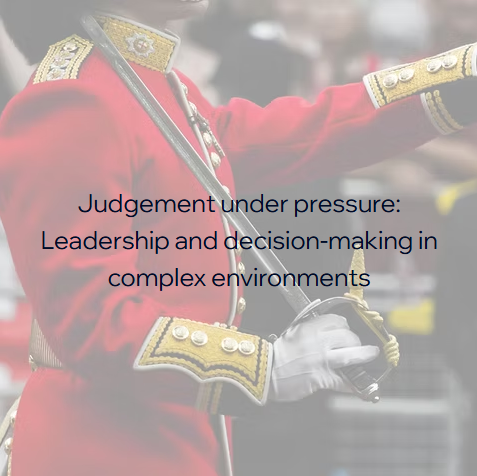
This research examined the relationship between leadership, decision-making, and performance within high-pressure environments, with a particular focus on how individuals and teams operated under conditions of uncertainty.
The study explored how cognitive, behavioural, and contextual factors shaped decision-making, highlighting the influence of experience, training, and situational awareness on outcomes. It considered how individuals interpreted information, managed ambiguity, and responded to evolving demands, particularly where time constraints and consequence were significant.
Drawing on established leadership and psychological theory, the research presents performance as the product of both individual capability and the surrounding environment. It highlights the interaction between structure, leadership approach, and team dynamics, and how these factors can either support or undermine effective decision-making.
The findings contribute to a broader understanding of how leadership and behaviour operate in practice, offering insight into the conditions required for effective performance in complex and demanding settings.

This research examined the lived experiences of mental health professionals working within a UK higher education setting, with a particular focus on how they were supported in roles characterised by sustained psychological demand.
The study identified a disconnect between formal support structures and the realities of practice. While organisational mechanisms were in place, they were often operationally focused on high-risk cases, with less attention given to broader staff wellbeing. In practice, support was frequently inconsistent, shaped by accessibility, local context, and the approach of individual managers.
Peer support emerged as a critical component, though its effectiveness was increasingly challenged by hybrid working and reduced day-to-day interaction. Wider systemic issues included navigating the tension between educational and healthcare environments, gaps in policy, and support processes that overlooked lower-risk but cumulatively demanding cases.
The findings highlight the need for more consistent, accessible, and systemised approaches to support, with greater emphasis on staff wellbeing as a core organisational priority.

This research examined tattooing as a lens through which to understand the relationship between the mind and body, with a particular focus on tattooing among military personnel and how conscious physical modification reflects deeper psychological and physiological processes.
The study explored the motivations behind tattooing, including identity, memory, and self-expression, alongside the embodied experience of the process itself. It highlighted how psychological state influenced the perception of pain and meaning, while physiological responses such as immune activity and endorphin release shaped the overall experience.
Drawing on theoretical perspectives such as embodiment theory and symbolic interactionism, the research presented tattooing as a bi-directional interaction between mind and body, where meaning is both constructed and physically experienced. Evidence suggested that tattooing can play a role in coping, identity formation, and emotional processing, while also raising questions around social context and long-term impact.
The findings contribute to a broader understanding of how behaviour, physiology, and meaning interact, offering insight into the relationship between psychological experience and physical expression within a military context.