Decoding the Mind-Body Connection in Military Ink, the Soliders Canvas
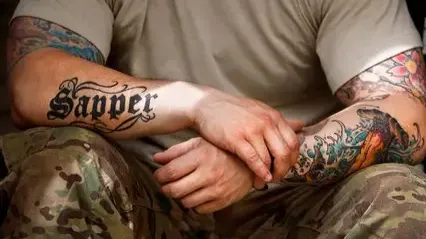
In tattoo studios across the country, a rhythmic buzzing provides the soundtrack to a transformation that is as old as warfare itself. To the uninitiated, it is simply a needle moving at high frequency. But for the soldier sitting in the chair, it is a physiological bridge; a mind-body dialogue that turns internal resolve into external reality.
In the British military, within every regiment or corps, tattoos are not merely fashion; they are embodied archives. They are the permanent record of a mind and body which has so often been pushed to its absolute limits.
In 2025 I presented 'Ink & Insight' (Morrad & O’Callaghan, 2025), this article explores why the soldiers canvas is a vital tool for resilience, identity reconstruction, and psychological survival.
I. The psychological motivation: The tribe and the individual
The presentation Ink & Insight categorised the reasons people get tattoos into two primary areas: Social and Cultural vs. Individual and Personal. In the military community, these two spheres are inextricably linked through a process known as symbolic interactionism.
The Parachute Regiment: The Pegasus and the Wings
For a member of the Parachute Regiment, the 'Wings' are the ultimate symbol of the mind's victory over the body's fear. It is a deeply held tradition for a Para to have his regimental cap badge tattooed on his right shoulder. By tattooing the 'Wings', the soldier is engaging in what my research referred to as identity reconstruction. They are taking a military symbol and making it a permanent part of their biological self. Their 'Wings' represent the successful navigation of P-Company, a selection process designed to find the breaking point of the human spirit. When that soldier looks in the o serves as a constant feedback loop. In terms of my research, this is the Mind-to-Body link in action: the psychological state of pride and achievement manifests as a physical, permanent modification.
The Royal Marines: The globe, laurel, and the dagger
Similarly, the Royal Marines often carry the Globe and Laurel or the Fairbairn-Sykes commando dagger. My research identified group symbols as a primary psychological motivator for tattooing. For a Royal Marine, the commando dagger represents the commando spirit; a specific set of values including courage, determination, and unselfishness.
By etching the dagger into the forearm or chest, a Royal Marine is utilising embodiment theory. This theory, a cornerstone of the Ink & Insight research, suggested that our thoughts and feelings are deeply rooted in our physical state. The Royal Marine is no longer just carrying a knife; they are becoming the knife. This symbolic merger helps maintain a specific identity even when they are off-duty. It is a permanent psychological anchor that prevents the individual from losing their sense of self in civilian environments.
The physiology of the mark: A bio-interaction of resilience
To understand why these markings carry such weight, we must move past the symbol and into the biological reality. As my researched outlines, tattooing is a high-intensity embodied event involving three layers: the epidermis, dermis, and hypodermis.
The endorphin armour
The act of tattooing is a voluntary bio-interaction. Unlike the trauma of a battlefield wound, the pain of the needle is chosen. When a soldier sits for a multi-hour session to have a battlefield cross or a regimental crest tattooed, the physical pain triggers the brain to release a massive surge of endorphins and enkephalins.
For combat veterans, this neurochemical response often mimics the high of high-stakes operations. It creates a state of intense focus and calm. In this link, the psychological desire to honour a unit's history drives the physical endurance of the pain. The tattoo becomes a neurochemical anchor, associating the memory of the unit with a state of physiological triumph over pain.
The immune system’s memory: Macrophages as archivists
The research provided a fascinating look at the role of macrophages. These immune cells rush to the tattoo site to clean up the ink, perceiving it as a foreign invader. When these cells die, they release the ink, which is then swallowed by new macrophages.
Biologically, the tattoo is a living, breathing part of the soldier’s immune system. When a Royal Marine tattoos the Globe and Laurel, his body is literally holding onto that identity at a cellular level. It is the ultimate synthesis: the mind chooses the symbol, and the body’s biological defence system preserves it forever.
Reclaiming the body: From government property to self-mastery
In the military, the body is often treated as government property. It is subject to strict regulations, uniform codes, and extreme physical stress. Tattooing offers a way to reclaim embodiment; viewing the body and mind as an integrated, self-directed whole.
The Swami research: Uniqueness and self-esteem
Research by Viren Swami (2011), cited extensively in my own research, found that tattoos significantly reduce appearance anxiety and increase perceptions of uniqueness. In a sea of identical uniforms and short back and sides haircuts, the tattoo is the only thing the soldier truly owns.
For the Paratrooper or Marine, the 'Wings' or 'Dagger' tattooed on the skin is an act of reclaiming the body. It is a transition from being a subject of the military to being the author of one's own narrative. This is particularly crucial during the transition to civilian life. When the uniform is handed back, the identity collapse can be devastating. However, the ink remains. It provides a bi-directional link that maintains the veteran's self-esteem and sense of elite status, even when they are wearing a civilian suit.
The therapeutic lens: Ink as a coping resource
Perhaps the most profound application of the mind-body connection in the military is the use of tattoos as a coping resource.
Kaufman’s combat soldiers and the memorial tattoo
Research by Kaufman et al. (2025) specifically identifies tattooing among combat soldiers as a resource for dealing with service experiences. The memorial tattoo; names of the fallen, dates of tours, or 'Lest We Forget' imagery is a form of identity reconstruction.
These are embodied memories. By placing the trauma and the loss on the outside of the body, the soldier can begin to process it on the inside. The physical act of getting the tattoo serves as a ritual of grief. The pain of the needle provides a cathartic release for the psychological pain of loss. It is a way of saying, "I carry my brothers not just in my heart, but in my skin."
The body-to-mind feedback loop
The body-to-mind link suggests that the physical state can influence the mental state. When a veteran struggling with invisible wounds; such as PTSD or anxiety looks down and sees the commando dagger or their cap badge, it sends a physical signal to the brain. It reminds the individual of their training, their resilience, and their membership in an elite community. The tattoo acts as a physical grounding technique, pulling the mind out of a flashback and back into the present reality of their strength.
Critical evaluation: The science of the skin
While the link between military identity and ink is culturally undeniable, the Ink & Insight presentation I gave last year rightly calls for a critical look at the physiological evidence gap. Most of the current data is correlational; we know that elite soldiers have tattoos and that those tattoos help them cope. However, the military community would benefit from more longitudinal studies to understand how these tattoos affect mental health over decades. Does the 'Warrior Identity' provided by the tattoo become a burden later in life if the veteran cannot reconcile their military past with their civilian present?
Furthermore, the influence of social stigma is changing. What was once seen as a rebellious act is now a standard rite of passage in the Parachute Regiment and Royal Marines. As the mind-body science evolves, we may see tattoos being used more formally as part of recovery programs for those suffering from combat-related trauma.
Conclusion: The permanent dialogue
The mind-body connection is often discussed in abstract terms, but in the military, it is written in ink and blood. The 'Wings' on the shoulder of a Paratrooper and the Commando Dagger on the arm of a Marine are not just decorations; they are neuro-biological anchors.
They represent the moment where the mind’s willpower was etched into the body’s dermis. They are symbols of resilience that bypass the need for words, communicating a legacy of service, sacrifice, and survival. As we look through the lens of tattooing, we see that it is the ultimate evidence of the mind-body link; a permanent, living dialogue that says: "I am here. I have survived. I will never forget."
For the modern veteran, the tattoo is the last piece of equipment they never have to turn in. It is the permanent mark of a life lived at the edge, a psychological shield forged in the fires of the dermis.
There is no doubt in my mind hat there is a much larger piece of work to be done here, one to add to the list!
Key Research Foundations:
Kaufman, M. L., Cohen-Louck, K., & Iluz, Y. (2025). Tattooing among combat soldiers as a coping resource with their military service experiences. Stress and Health.
Oreg, A., Erel-Brodsky, H., & Taubman–Ben-Ari, O. (2024). Embodied memories—exploring
memorial tattoos through the lens of terror management theory. Death Studies.
Swami, V. (2011). Marked for life? A prospective study of tattoos on appearance anxiety and dissatisfaction, perceptions of uniqueness, and self-esteem. Body Image.
Morrad, R., & O’Callaghan, T. (2025). Ink & Insight: Tattoos as a novel lens on the mind-body connection. University of Plymouth.

Comments